Dangerous Look-alikes Found in Canadian Forests

Amanita phalloides (death cap). Photo: Wikimedia Commons / CC BY-SA 3.0. This species has been confirmed in British Columbia and is expanding eastward.
This article covers toxic species
The comparisons below describe mushrooms that have caused severe poisoning and death in Canada and elsewhere. The information is provided to help readers recognise and avoid these species — not to provide positive identification of edible mushrooms. Never eat a wild mushroom identified using this or any website alone.
Why Look-alike Knowledge Matters
Most wild mushroom poisoning incidents in Canada follow a similar pattern: a forager collects a familiar-looking species without checking structural characteristics that would have revealed the error. Look-alike awareness does not replace systematic identification — it reinforces why each step of that system exists.
The confusion pairs below represent the most consequential misidentifications reported in Canadian contexts, based on case reports in medical literature and regional poison control advisories.
Pair 1: Death Cap vs. Young Paddy Straw Mushroom / Button Mushrooms
Amanita phalloides (death cap) has been confirmed in British Columbia, where it was introduced through movement of horticultural trees from Europe. It has spread through urban and suburban areas along the coast. Cases involving immigrant communities — particularly those from regions where the paddy straw mushroom (Volvariella volvacea) is a familiar edible — have been documented in BC.
Both species emerge as white or pale egg-shaped forms partially enclosed in a universal veil. At the button stage, before the cap expands, visual similarity is high. The key structural difference is the stipe base: Amanita phalloides emerges from a cup-like volva — a sac of tissue at ground level — that is often buried. Paddy straw mushrooms lack this volva structure.
The spore print resolves this pair clearly. The death cap prints white; edible Agaricus species print chocolate-brown. A stipe-base inspection — digging carefully to reveal any volva — is essential for any white-gilled, white-capped species collected from the ground.
Pair 2: Galerina marginata vs. Honey Mushrooms

Galerina marginata. Photo: Wikimedia Commons / CC BY-SA 3.0
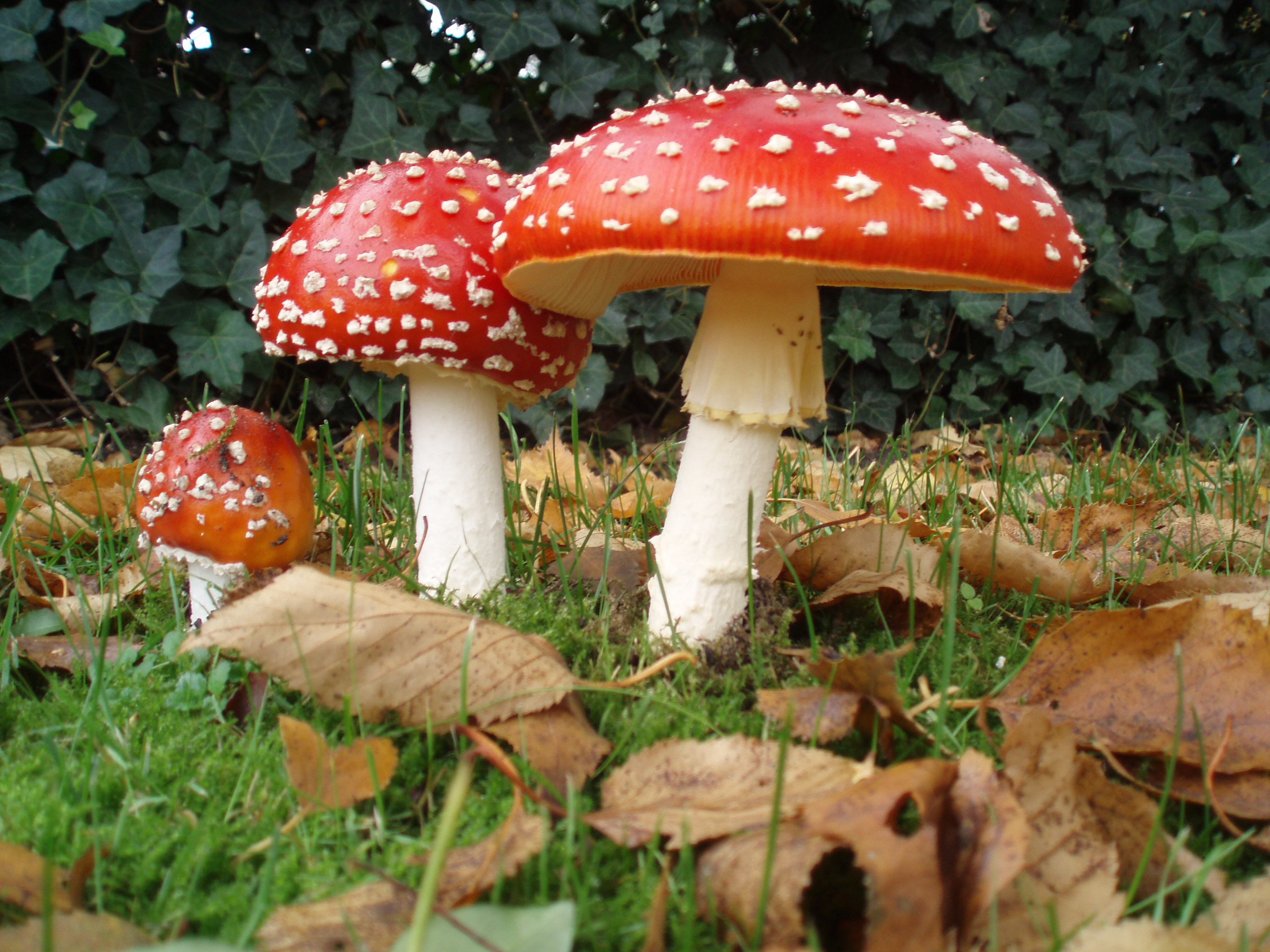
Amanita muscaria. Photo: Wikimedia Commons / CC BY-SA 3.0
Galerina marginata grows on decaying wood — stumps, buried roots, fallen logs — across every Canadian province. It fruits in clusters from spring through fall, with a peak in autumn. The cap is tawny to rust-brown, the stipe is slender, and a fragile ring is often present. Honey mushrooms (Armillaria ostoyae, A. sinapina, A. gallica) grow in very similar situations and are among the most widely harvested edible mushrooms in Canada.
The most reliable field separator is the spore print: honey mushrooms print white; Galerina marginata prints rust-brown. The stipe comparison also helps — honey mushroom stipes are typically more robust relative to cap size, and the ring is often cottony and persistent. Galerina stipes are slender, fragile, and the ring is thin and may disappear with age.
Never mix specimens from different clusters or growth sites when collecting honey mushrooms. A cluster that appears to be all one species may include Galerina growing nearby or intermingled. Examine and print each cluster independently.
Pair 3: True Morel vs. False Morel
True morels (Morchella species) are among the most sought spring edibles in Canada. They appear in May in southern Ontario and Alberta, often near old elm trees, ash stands, and in areas that burned the previous year. The cap is entirely hollow when cut vertically, with a continuous cavity through cap and stipe. False morels (Gyromitra species) fruit at the same time and in overlapping habitats.
Gyromitra esculenta contains gyromitrin, which converts to monomethylhydrazine in the body — a compound that can cause liver failure. Poisoning has been fatal. Some European traditions involve parboiling false morels before consumption, but this process is unreliable for toxin removal and is not recommended. The safest approach is to collect only confirmed true morels, cut each specimen lengthwise to verify complete hollowness before adding to a basket, and discard any specimen with internal chambers or irregular hollow structure.
Pair 4: Golden Chanterelle vs. Jack-o'-Lantern Mushroom
The jack-o'-lantern (Omphalotus olearius and O. illudens) is not found as widely in Canada as in the US, but records exist in Ontario and Quebec. It causes gastrointestinal poisoning within hours of ingestion — severe vomiting and cramping that resolve without permanent organ damage but require medical assessment.
The two-part test — gills-versus-ridges and spore print — resolves this pair conclusively. A forager who applies both checks will not confuse a chanterelle with a jack-o'-lantern. The habit difference is also useful: chanterelles grow from soil in association with tree roots underground; jack-o'-lanterns grow visibly from wood or at tree bases.
Pair 5: Wood Blewit vs. Violet Webcap
Wood blewit (Lepista nuda) is an edible autumn mushroom with violet-tinted gills, stipe, and cap. It is found in leaf litter across Ontario, Quebec, and BC. Several violet-coloured Cortinarius species fruit in the same habitat at the same time of year.
The key separator is the spore deposit: wood blewit prints pale pink; Cortinarius species print rust-brown. Young Cortinarius specimens also retain a cobwebby partial veil (cortina) between the cap edge and the stipe — thin strands that differ from the more ring-like structure seen in other genera. The cortina often leaves a faint rust-brown ring zone on the stipe from trapped spores as the mushroom matures.